Maritime Industry
The maritime industry, which comprises shipping companies, ship manufacturing, and port authorities, has slowly begun to undergo a digital transformation. In VoxelMatters‘ analysis, the maritime industrial sector intended to encompass all navigation-related applications, including marine industry products such as sailing boats and yachts, and above or underwater energy applications (both fossil and renewable). In VoxelMatters’ Core AM and Vertical AM data, maritime AM is listed under the “Freight” category, which also includes other cargo transports such as railroads.
Automation is gaining increasing interest across the maritime industry. Advanced software and simulation capabilities are emerging and maritime connectivity improved. Not until very recently, however, did the digital transformation in the maritime industry apply to manufacturing – and specifically to additive manufacturing processes.
There are multiple reasons why AM was slower to enter maritime industry manufacturing processes and they depend largely on the type of ships. For example, in the yachting industry, AM already proves ideal for many types of parts – even small parts – due to the very small size of batches required. However, operators in this industry are traditionally very slow to adapt to change. Recently, with some pressure from LFAM composites hardware system manufacturers operators in the yachting industry have begun to explore the opportunities for large format mold production using AM and adoption has significantly accelerated.
There are of course exceptions, especially in what we consider marine (rather than maritime) applications. This segment includes racing boats (especially in America’s Cup, where technological advancements and weight containment are major issues), as well as luxury yachts. Here we have seen heavy use of AM technologies for the production of small part batches or custom components. In some exploratory cases, composite (CFR or GFR) materials have enabled additive manufacturing of very large parts using materials that provide sufficient chemical and environmental resistance to be used in the tough marine environment. In one case, even an entire submarine hull was 3D printed in a joint project involving ORNL and the US Navy.
In the transportation industry, thus in seaport and large ships applications, the biggest limit was part size. As new DED, WAAM and blown powder processes have enabled faster additive production of much larger parts, a slew of new applications have emerged to enable direct and cost-effective production of marine parts such as propellers, submarine ballasts and several other parts.
Yet another key application of AM for the maritime industry is on-demand part replacements. In this case, AM has shown to be applicable both within onshore shipyards/ports and directly on-board large ships such as – but not limited to – aircraft carriers that have to spend a long time at sea.
Finally, 3D printing, even with concrete-based or ceramic materials, has proven useful for building underwater structures and even help rebuild coral barriers and more recently for on-location production of large wind turbine towers. These applications fit more within the realm of construction 3D printing, however, they have already shown enormous potential. Below you will find the latest updates on most relevant news and application cases for AM in the maritime industry.
-
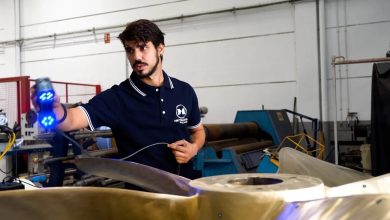
METALNOX cuts propeller repair time by 20% with SHINING 3D tech
METALNOX, a Mallorca-based propeller repair specialist, has reduced its propeller repair cycle time by 20% after integrating SHINING 3D‘s FreeScan Combo Series handheld 3D scanner into its workshop operations. The…
-
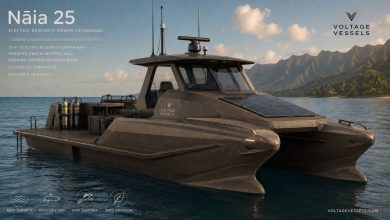
Voltage launches Eclipse X9 basalt-PETG composite for large-format AM
Hawaiian company Voltage Vessels/Voltage Materials has launched Eclipse X9, a basalt-reinforced recycled PETG composite designed for large-format additive manufacturing, now available in both pellet and filament forms. The material has…
-
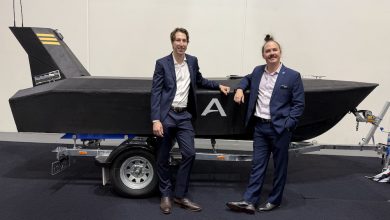
Hyperion Systems 3D prints 4.6m hull for ASTRA 460 USV
This week at the Indian Ocean Defence and Security Conference (IODS) in Perth, Australia, Hyperion Systems is making quite the splash. There, the Australian LFAM specialist is not only publicly…
-
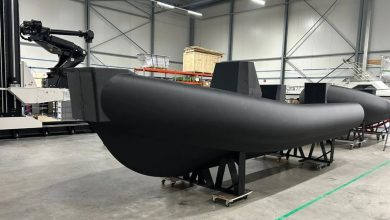
Voltage Vessels 3D prints boat hull with proprietary composite
Voltage Vessels, a Hawaii-based startup, has submitted a six-meter rigid hull inflatable boat (RHIB) for US maritime defense evaluation, with the vessel assessed for potential integration into autonomous naval programs. …
-
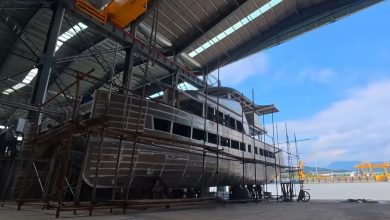
SHINING 3D’s FreeScan Trak quantifies hull geometry for aluminum electric catamaran
Hangzhou-based engineer and sailor Hu Wei has invested tens of millions of RMB into the HighWei 66, an electric catamaran built around variable-pitch electric propulsion, solar power generation, and regenerative…
-
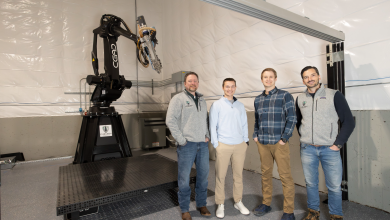
Airtech and Evergreen Additive sign exclusive supply agreement for maritime LFAM
Airtech Advanced Materials Group and Evergreen Additive entered into an exclusive supply agreement on May 20, targeting LFAM applications in the maritime and defense sectors. Under the deal, Airtech will…
-
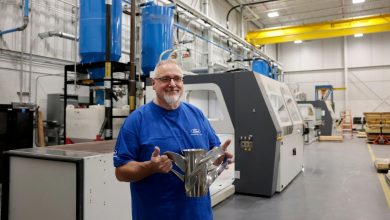
Ford and Sharrow Engineering cut propeller production time from months to weeks with 3D printed sand-casting
Ford Motor Company‘s Advanced Industrial Technology & Platforms (ATP) team and Sharrow Engineering’s partnership has led to significant cuts in lead time on a propeller being produced by the companies.…
-
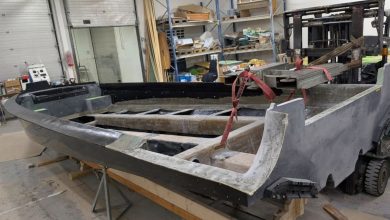
SHINING 3D scanners used to digitize 8-meter RIB hull
Traditional workflows in the boatbuilding sector typically rely on manual measurements and iterative physical adjustments — a process that can reduce efficiency and slow production cycles. A 3D printing solutions…
-
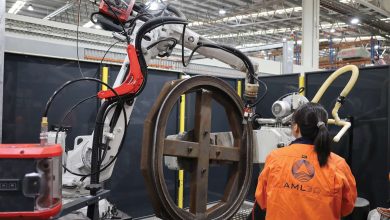
AML3D reports $20 million in YTD orders as US defence contracts drive quarterly growth
AML3D has recorded $2.2 million (AUD) in customer receipts for the quarter ending 31 March 2026, holding a consistent run rate across the previous four quarters and bringing total year-to-date…
-

Charles Darwin University leads on project to produce naval-grade alloy parts for Australian defense
Charles Darwin University (CDU) is leading a new project to produce nickel-aluminum-bronze (NAB) parts using SPEE3D’s cold spray manufacturing (CSM) technology, with the aim of testing their behavior in seawater.…


