Maritime Industry
The maritime industry, which comprises shipping companies, ship manufacturing, and port authorities, has slowly begun to undergo a digital transformation. In VoxelMatters‘ analysis, the maritime industrial sector intended to encompass all navigation-related applications, including marine industry products such as sailing boats and yachts, and above or underwater energy applications (both fossil and renewable). In VoxelMatters’ Core AM and Vertical AM data, maritime AM is listed under the “Freight” category, which also includes other cargo transports such as railroads.
Automation is gaining increasing interest across the maritime industry. Advanced software and simulation capabilities are emerging and maritime connectivity improved. Not until very recently, however, did the digital transformation in the maritime industry apply to manufacturing – and specifically to additive manufacturing processes.
There are multiple reasons why AM was slower to enter maritime industry manufacturing processes and they depend largely on the type of ships. For example, in the yachting industry, AM already proves ideal for many types of parts – even small parts – due to the very small size of batches required. However, operators in this industry are traditionally very slow to adapt to change. Recently, with some pressure from LFAM composites hardware system manufacturers operators in the yachting industry have begun to explore the opportunities for large format mold production using AM and adoption has significantly accelerated.
There are of course exceptions, especially in what we consider marine (rather than maritime) applications. This segment includes racing boats (especially in America’s Cup, where technological advancements and weight containment are major issues), as well as luxury yachts. Here we have seen heavy use of AM technologies for the production of small part batches or custom components. In some exploratory cases, composite (CFR or GFR) materials have enabled additive manufacturing of very large parts using materials that provide sufficient chemical and environmental resistance to be used in the tough marine environment. In one case, even an entire submarine hull was 3D printed in a joint project involving ORNL and the US Navy.
In the transportation industry, thus in seaport and large ships applications, the biggest limit was part size. As new DED, WAAM and blown powder processes have enabled faster additive production of much larger parts, a slew of new applications have emerged to enable direct and cost-effective production of marine parts such as propellers, submarine ballasts and several other parts.
Yet another key application of AM for the maritime industry is on-demand part replacements. In this case, AM has shown to be applicable both within onshore shipyards/ports and directly on-board large ships such as – but not limited to – aircraft carriers that have to spend a long time at sea.
Finally, 3D printing, even with concrete-based or ceramic materials, has proven useful for building underwater structures and even help rebuild coral barriers and more recently for on-location production of large wind turbine towers. These applications fit more within the realm of construction 3D printing, however, they have already shown enormous potential. Below you will find the latest updates on most relevant news and application cases for AM in the maritime industry.
-

DEEP Manufacturing prints WAAM marine propeller blade in NAB
DEEP Manufacturing Ltd has completed the printing of a Nickel Aluminum Bronze (NAB) marine propeller blade as part of the Digitally Enabled Efficient Propeller (D.E.E.P.) project, a consortium effort backed…
-

Red Cat Blue Ops integrates robotic 3D printing through HADDY partnership
Red Cat Holdings (Nasdaq: RCAT) equipped its maritime division, Blue Ops, with robotic 3D printing and AI-assisted production systems through a new strategic partnership with HADDY, a provider of large-scale…
-

AML3D secures $1.8 million contract to 3D print replacement parts for US Navy submarines
AML3D has received a AU$2.61 million ($1.8m) contract to manufacture five replacement components for in-service trials aboard US Navy submarines, with the order signed through BlueForge Alliance, a US nonprofit…
-

DEEP Manufacturing a year ahead of schedule with Houston WAAM facility
Large-scale AM specialist DEEP Manufacturing has moved up the official launch date of its new Houston, Texas facility to May of this year, a full 12 months ahead of its…
-

PNSY welds first-ever metal 3D printed submarine component
The Portsmouth Naval Shipyard (PNSY) has successfully inspected, tested, and welded the first additive manufactured copper-nickel flange aboard USS Washington. The milestone represents both the first time an AM copper-nickel…
-

AML3D receives $7 million ARCEMY X order from HII’s Newport News Shipbuilding
AML3D Limited has received an order valued at approximately $7.03 million (AUD $9.9 million) for four custom large-scale ARCEMY X 6700 additive manufacturing systems from Newport News Shipbuilding (NNS), a…
-

NAVSEA advances motion simulation platform for 3D printing at sea
The Johns Hopkins University Applied Physics Laboratory (APL) and GKN Aerospace have developed a motion simulation platform designed to replicate the dynamic conditions of a ship at sea. The key…
-
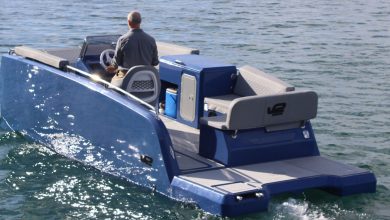
Caracol and V2 Group collaborate on 6-meter monolithic catamaran 3D print
Global leader in advanced robotic technologies Caracol has completed what it claims is “the first functional 6-meter-long monolithic catamaran for open waters” built entirely using its LFAM platform, in collaboration…
-
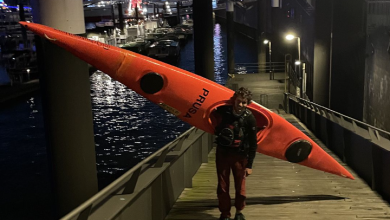
From a random idea, to an 800 km long trip in a 3D printed kayak
Less than a decade ago, during a casual meeting, David, an amateur rower, introduced to his friend Kuba an idea that initially sounded absurd. He proposed that they design and…
-

WAAM3D expands global footprint with deals in the US and Malaysia
WAAM3D and National Aerospace Industry Corporation Malaysia have signed a memorandum of understanding at the Singapore Airshow to establish wire arc additive manufacturing capabilities at the MyAERO Centre. NAICO positions…


