Advanced Polymers
Advanced Polymers – like the reference category of Advanced Materials – are intended by VoxelMatters Research as all polymers (photopolymer, thermoplastics and thermosets) that display unique and advanced characteristics. Typically advanced polymers used in 3D printing are PAEK family thermopolymers, available both as filaments and pellets for material extrusion technologies and as powders for PBF processes. These are materials that display unique characteristics in terms of strength as well as high-temperature and chemical resistance, making them suitable for metal replacement activities.
There are many producers and compounders of modified PEEK polymers in the world: companies and products include Lehmann & Voss (LUVOCOM), Victrex, SABIC, Solvay (KetaSpire) and Evonik (VESTAKEEP). Most of these companies also have made investments and hold significant stakes in the additive manufacturing industry.
Other thermoplastics that we consider Advanced Polymers include polyetherimide or PEI (usually referred to by its SABIC commercial name ULTEM) and, more recently, the family of polysulfones introduced for 3D printing mainly by Solvay. Polysulfones are a family of high-performance thermoplastics that in some applications can be used as an alternative to PAEK polymers or as a superior replacement for polycarbonates. Three polysulfones are used industrially, these are polysulfone (PSU), polyethersulfone (PES or PESU) and polyphenylene sulfone (PPSU).
The Advanced Polymers category doesn’t refer only to thermoplastics. Because they are digital materials whose properties can be accurately fine-tuned, many photopolymers also fall into VoxelMatter’s Advanced Polymers categorization. For example dielectric materials such as those developed by Fortify and Rogers Corporation, or highly durable materials that integrate thermosets such as those used in many high-speed photopolymerization processes.
While we don’t usually include “standard” chopped fiber CFR and GFR composites among Advanced Polymers (as they have their own Composites category), other types of composites that integrate and digitally orient ceramic fibers, graphene or CNTs fall into this category as well.
-
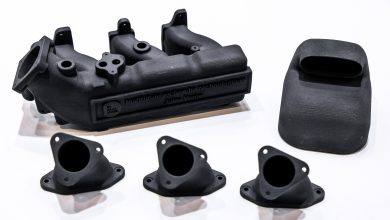
ALM polymer powders for industrial PBF now available on Farsoon systems
Farsoon Technologies expanded its open materials ecosystem by qualifying several high-performance polymer powders from Advanced Laser Materials (ALM) for use on its industrial polymer PBF systems. The collaboration made three…
-
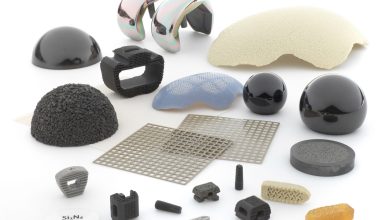
SINTX Technologies signs with Evonik to produce SiN/PEEK compound for 3D printed implants
SINTX Technologies, Inc. (NASDAQ: SINT) closed a deal with Evonik Corporation, a company that makes high-performance polymers, to have Evonik produce SINTX’s special silicon nitride–PEEK (SiN/PEEK) material on a large…
-

Expanding the foundations for the next decade of AM growth at Formnext
In Part 1 and Part 2 of this article series, we discussed additive manufacturing of polymers and metals, highlighting serial production capabilities as a key growth driver. However, the primary…
-

Laying the foundations for the next decade of AM growth at Formnext 2025
Before beginning this article, I went back and checked last year’s Formnext end-of-show roundup to see if our impression of this year’s show was consistent with what we saw last…
-
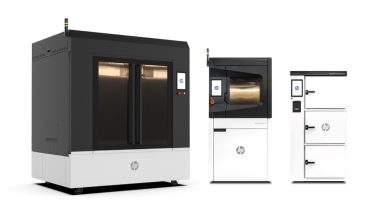
HP launches HP IF 600HT industrial filament 3D printer at Formnext 2025
At Formnext 2025, HP Additive Manufacturing is unveiling the HP IF 600HT, a new industrial 3D printer (to be launched in H1 2026, followed by a larger model in H2…
-

Aether launches RapidPrint filaments for faster high-performance 3D printing
Aether has introduced RapidPrint, a new line of polymer filaments engineered to accelerate additive manufacturing for high-performance applications. The company reports that, depending on printer and part design, the new…
-

Lumas Polymers releases settings for LumaSint PK 5000 on Formlabs Fuse 1+ 30W
Lumas Polymers (formerly part of Jabil Additive) has released Formlabs Print Setting (FPS) files for its high-performance SLS powder, LumaSint PK 5000, which are now compatible with Formlabs Fuse 1+…
-

Stratasys launches P3 Silicone 25A for Origin DLP 3D printer
For years a challenging, near-impossible material to 3D print, silicone is now becoming increasingly available to 3D printing users, enabling them to take advantage of the material’s unique blend of…
-
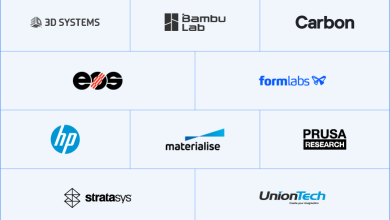
These are the top 10 polymer AM companies by revenue in 2024
The leading companies in the polymer additive manufacturing market are, in most cases, hardware manufacturers that also generate revenue from proprietary materials and sometimes AM services. These top 10 polymer…
-
TrueSilX50: Axtra3D pushes boundaries of silicone 3D printing
Since it launched just a couple years ago, Axtra3D’s Hi-Speed SLA has offered manufacturers a more efficient method for producing molds and mold inserts, among other applications. The company’s HPS…


