Dental AM
Dental additive manufacturing became the first segment to achieve the production of certain end-use parts, effectively fueling growth for all main traditional polymer additive manufacturing hardware and material stakeholders. Photopolymerization (and material jetting, which is a type of photopolymerization) companies such as Stratasys, 3D Systems, EnvisionTEC, DWS and Prodways – embraced the dental AM segment first.
They were followed by two different categories of companies. On one hand, leading dental companies that began developing their own dental 3D printers (mainly based on DLP technology) and 3D printing-specific dental materials. On the other, leading metal laser PBF hardware providers such as EOS, 3D Systems, SLM Solutions, TRUMPF and Renishaw above that began targeting permanent dental implants as a key business area. More recently, leading ceramic AM firms, such as Lithoz, 3D Ceram and XJet got involved more directly and are seeing significant opportunities for dental implants directly 3D printed in ceramic.
Even more recently the next generation of polymer AM companies entered the arena targeting true digital mass production. Boston-based Formlabs entered the segment providing an accessible and low-cost solution mainly for dental models, while Silicon Valley-based Carbon also entered the market with new materials and the ability to provide very high productivity both for models and tools for custom thermoformed aligners. Both solutions have dramatically increased AM penetration within the entire dental industry at all levels, including the dentist’s office. However, HP was the first company to achieve a million-part application in dentistry by using its technology indirectly, to produce millions of mass-customized tools for dental aligners manufactured by Smile Direct. In fact, dental aligners – including those manufactured by market leader Invisalign – are now one of the hottest applications in this segment.
In general, polymer 3D printers and materials are used in dentistry on several levels: to directly produce models from intraoral scans, CT scans and MRI’s; to produce patterns and molds for end-use materials; to produce visual models, surgical guides and even temporaries – with some now envisioning the direct production of permanent prostheses using polymer-nanoceramic composite materials. Metal and ceramic 3D printers and materials are used as real alternatives to subtractive production methods, reducing material waste.
Historically, dental additive manufacturing technologies have been applied in dental laboratories for over two decades, and more recently they have begun to be adopted by dentists, orthodontists, and oral surgeons. The use of 3D printing in the laboratory and the dentist’s office has been steadily growing for the past several years. Now the dental opportunity has emerged as one of the most relevant for the AM industry as a whole, with literally hundreds of thousands of potential adopters all over the world.
The apparent paradox is that – as dental technologies become more and more established within the dental industry – AM’s visibility within the dental segment has been progressively decreasing, as adopters now increasingly see it as standard practice. In this month’s AM focus we are going to highlight the latest opportunities for AM in dentistry.
-
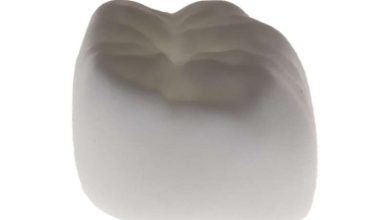
UT Dallas researchers 3D print zirconia for dental restorations
According to the University of Texas at Dallas (UT Dallas), researchers have developed a technology that enables same-day, 3D printed dental restorations made of zirconia, the gold-standard material for permanent…
-
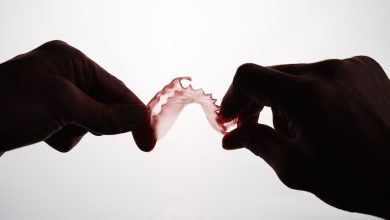
Carbon launches dual-cure FP3D resin for flexible partial dentures
Earlier this month, 3D printing company Carbon disclosed it was preparing to release a new technology solution that would dramatically improve post-processing workflows. While we will have to wait until…
-
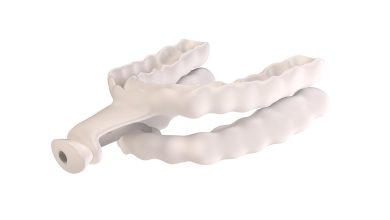
3D printed sleep apnea device receives FDA clearance
Airway Management, a developer of advanced oral appliances, has achieved FDA clearance for its Nylon flexTAP, one of the first digitally printed single-point midline oral appliance devices for sleep apnea.…
-
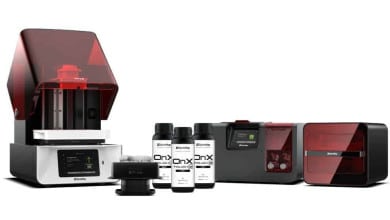
SprintRay acquires EnvisionTEC/ETEC portfolio of dental products
SprintRay, a dental 3D printing company, has acquired the EnvisionTEC/ETEC (formerly part of Desktop Health) portfolio of dental products, including its patents, trademarks, inventory, and other intellectual property related to…
-
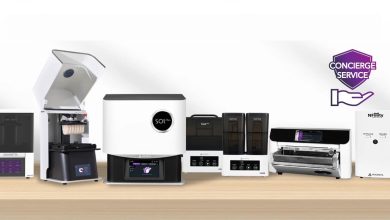
Pac-Dent acquires Ackuretta Technologies
Pac-Dent, Inc., a global manufacturing leader in preventive care, infection control, Rodin dental 3D printing resins, along with 3D printing–oriented restorative materials, had acquired Ackuretta Technologies (established in 2013), a…
-
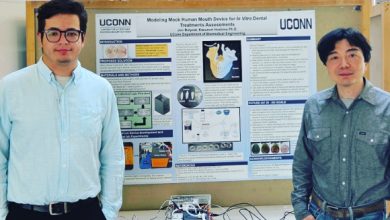
UConn engineer 3D prints ‘mock human mouth’
According to the University of Connecticut (UConn), Jon Balyeat, a biomedical engineering major, has created a 3D printed “mock human mouth” — a device meant to simulate the oral cavity’s…
-
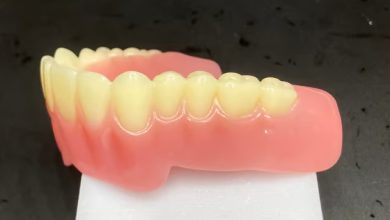
3D Systems releases FDA-cleared NextDent Jetted Denture Solution
3D Systems is rolling out its newest commercial dental offering, the NextDent Jetted Denture Solution, for the United States market. The FDA-cleared 3D printed denture solution is reportedly the first…
-
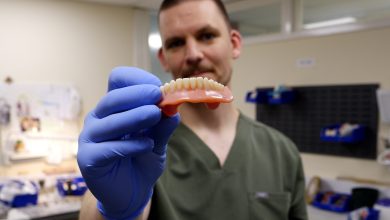
SYS Systems reports 350% surge in dental market sales
SYS Systems, a UK-based industrial equipment supplier, has reported a 350% surge in sales in the dental market, as thousands of patients take advantage of 3D printing technology. The company…
-
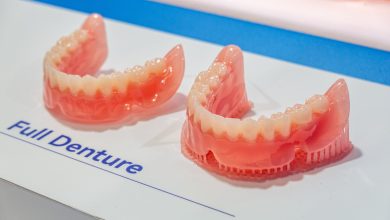
HeyGears launches 3D printed single-piece dentures
HeyGears, a developer of desktop 3D printing technology, recently unveiled its Multi-Material Fusion resin 3D printed single-piece dentures. These OnePrint Dentures leverage HeyGears’ photopolymerization technology to directly 3D print products…
-
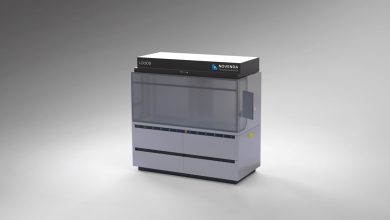
Novenda Technologies secures $6.1M to launch material jetting solution for dental
The dental industry is facing mounting pressure to increase manufacturing efficiency, particularly in markets where centralized manufacturing is becoming the norm. In response to this demand, Novenda Technologies has just raised $6.1 million…


