Züblin and Instatiq leverage concrete 3D printing at scale
Using an Instatiq P1 concrete printer to produce solid walls instead of only formwork

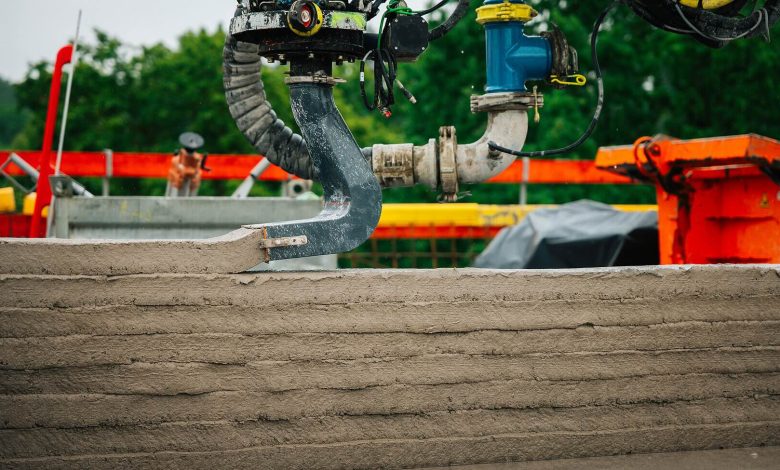
Züblin, a German construction company, and Instatiq, a research and product development company, are using 3D concrete printing for the production of three apartment buildings for GWG Reutlingen in Metzingen-Neugreuth.
The top floor of one of the four-storey buildings is printed directly on the construction site, using an Instatiq P1 concrete printer. The printed walls reach a height of up to three meters and a thickness of 16.5 to 19 centimeters. They are produced at a speed of up to 10 centimeters per second and have a maximum output of 2.5 cubic meters per hour.
“With 3D concrete printing, we bring an innovative and automated process directly to the construction site. We use it to build the load-bearing walls of the storey in just four days. One cubic meter of printed solid wall requires only half the time of conventional limestone masonry construction, as used on the other floors. This not only saves us time, but is also our response to the ever-increasing shortage of skilled workers. And our employees benefit from better working conditions with less dust and noise,” said Chris Brandstätt, Group leader for process planning in construction operations at Züblin.

“The enormous technical advantage over other 3D concrete printers is that we print solid walls and not just formwork – and we do this directly with material from a conventional concrete mixer. This means that no special building materials have to be delivered over long distances. The financial savings are obvious. At the same time, the machine fits perfectly into the work processes on the construction site and has an enormous reach with its 26-meter-long, automatically controlled boom arm,” said Fabian Schüler, Chief Financial Officer at Instatiq.
The process stands for consistent digitalization of the construction process. Construction plans no longer need to be printed out, which reduces the susceptibility to errors and improves quality assurance. Printing is carried out using a concrete mix that produces around 20% less CO₂ emissions than traditional limestone masonry.
“As a developer, we see our task not only in constructing buildings, but also in creating spaces for innovation – and bringing progress to the region. With the 3D concrete printing project in Metzingen, we want to consciously test alternative construction methods – resource-saving, efficient, and future-oriented. For us, this is a strong signal: we are ready to take responsibility for the future of construction,” said Florian Bertz, Technical Department Manager at GWG Reutlingen.
A total of 44 modern and sustainable residential units are being built on the approximately 3,000 square meter site in Metzingen, including 18 publicly subsidized and six barrier-free apartments. The three apartment buildings are scheduled for completion in May 2026. Further projects using the 3D concrete printer are already being planned. The services will soon be offered by a joint venture between Züblin and Instatiq called Nelson, subject to the necessary antitrust approvals.


