Tripo AI, a company that we’ve been tracking for some time for its focus on 3D foundation models, closed two consecutive financing rounds—Series A+ and Series A++—totaling nearly $200 million. The company said the capital would go toward expanding its AI 3D and world model research teams, accelerating core algorithm development, and broadening its global product presence.
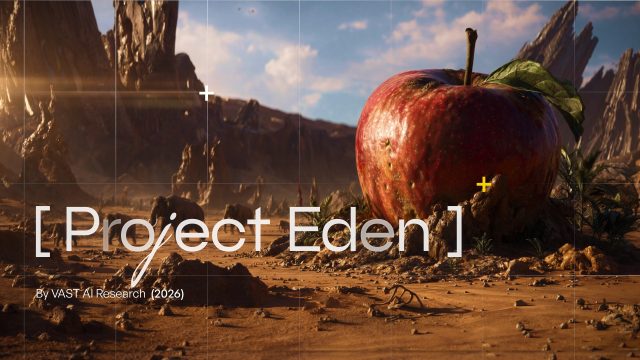
Alongside the fundraise, Tripo AI introduced Project Eden, a world model research initiative aimed at building persistent, reusable, and multiplayer interactive environments—a significant step beyond the image-to-3D and text-to-3D generation work that defined the company’s earlier product releases.
The technical architecture behind Project Eden separates world state management from visual rendering across three discrete layers. The first, the Structured State Layer, maintains the underlying 3D environment—scene geometry, object identity, attributes, and event logic—independently of any camera viewpoint. The second, the State-to-Observation Interface, converts that world state into semantic and geometric conditions for rendering from different perspectives, with each view derived from the same underlying data to maintain consistency. The third, the Generative Rendering Layer, produces detailed visual output in real time from those state-derived conditions.
The decoupled architecture is designed to enable three capabilities: long-horizon environmental persistence, where worlds maintain consistent state across viewpoint changes and user exits; editable worlds, where modifications made by one user or agent persist for others; and concurrent multiplayer interaction, where multiple participants share a single evolving world state while each receiving an individually rendered view.
Tripo AI positioned Project Eden as both a platform for interactive content creation and a simulation base for embodied AI research and multi-agent evaluation.
On the generative 3D side, Tripo AI’s most recent foundation model releases — Tripo H3.1, targeting high-precision geometry generation, and Tripo P1.0, focused on production-ready mesh output within seconds — were introduced in March 2026 and remain the current generation of the company’s core offering.
Tripo Studio, the company’s professional 3D workspace, received two capability updates alongside the financing. Native 8K AI texture generation was added to keep generated assets visually sharp at close range and across scale, with support for export to Unreal Engine, Unity, and Blender pipelines. Intelligent Part Segmentation V2 updated the existing segmentation feature with a 2D pre-segmentation preview and three levels of output granularity — low (3–6 parts), medium (6–15 parts), and high (15 or more parts) — covering use cases from 3D printing and concept presentation through to game development, film production, and mechanical assembly. The feature can be combined with Tripo AI’s Quick Cap tool to support a complete workflow from asset generation through segmentation, capping, and printing.
The company also wrapped its third season of open-source releases, focused on dynamic content, new 3D representation methods, and real-world applications. New projects included TripoSplat, developed with Tsinghua University, which introduces a density control method for 3D Gaussian representation with learnable probabilistic sampling; AniGen, developed with the University of Hong Kong, which generates animatable 3D assets including geometry, texture, skeleton, and skinning from a single image; SkinTokens, also from Tsinghua University, which converts skinning weights into token form for use within autoregressive generation frameworks; and LegoACE, which autoregressively generates physically buildable LEGO models from text or image inputs.


