
Dutch designer Anouk Wipprecht is consistently at the cutting edge of fashion and technology. For years, we’ve been wowed by her highly innovative designs, including her SpeakerDress from 2017, a sort of futuristic wearable boombox; the clever Proximity Dress designed for social distancing in 2020; and the Illuminating Dress in 2023 that responds to its environment using LED lights. Her latest project, called the Hypnotize Dress, continues this creative trajectory by merging 3D printing, electronics, and neurotechnology.
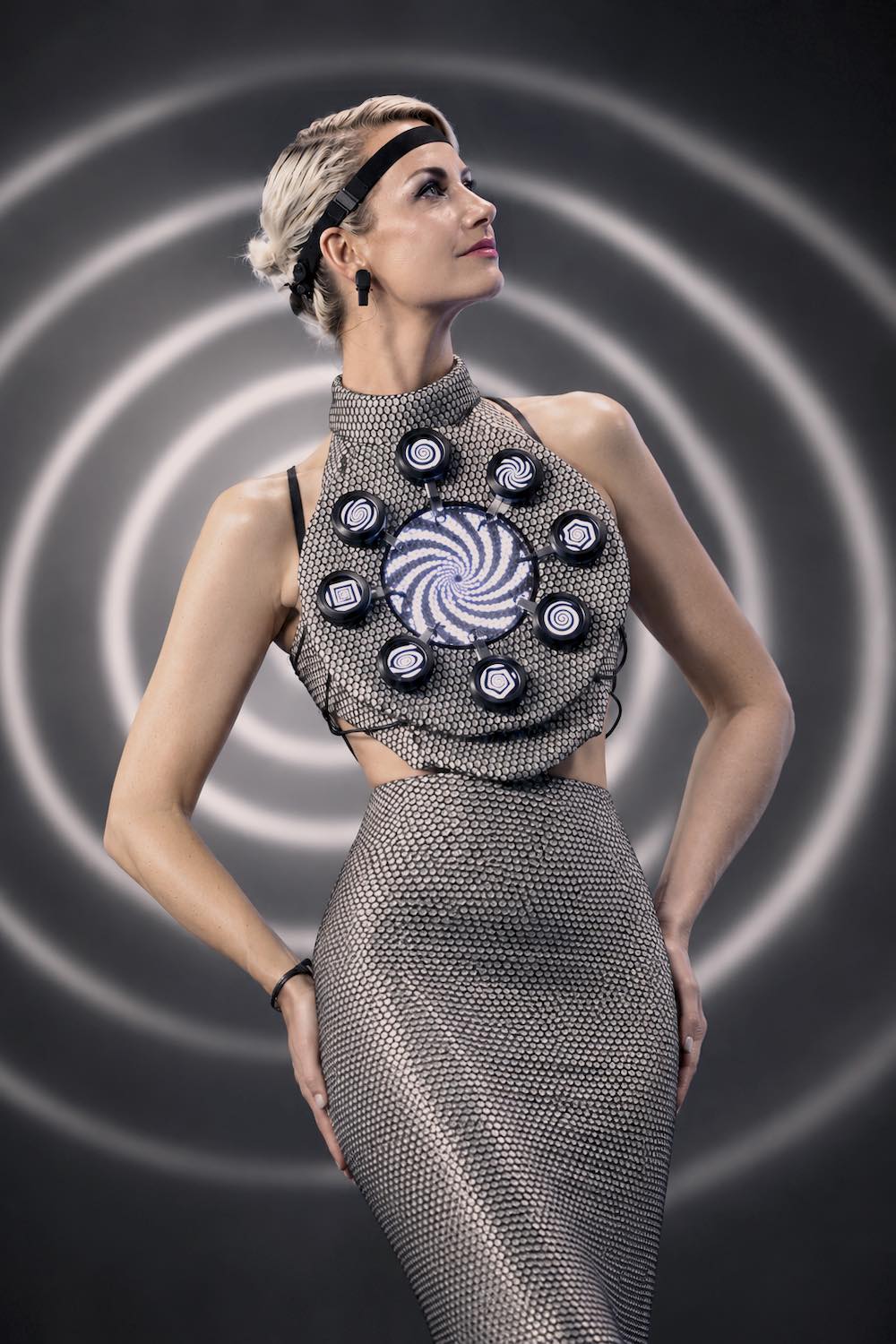
In more specific terms, the Dutch designer teamed up with neurotechnology company g.tec to use its Unicorn BCI-Core EEG headset to capture brain activity data. This data is then translated into a concentration metric that influences the pattern of eight display panels built into the dress. As the designer explains it: “The EEG data is used to estimate a trained concentration-performance value between 0 and 100. That continuously changing value is mapped to the animation running across the eight displays.”
The eight circular screens are mounted on the dress using a 3D printed architecture and display hypnotic black and white patterns. When the wearer’s concentration increases, the movement of the patterns accelerates, which could have a hypnotic effect on the viewer. When the wearer loses concentration, the patterns slow down accordingly. “I’m interested in what happens when the interface isn’t a screen in front of you, but something you wear,” Wipprecht said.


The notion of externalizing something happening within the wearer and presenting it through fashion is not totally new to Wipprecht. In 2023, before the Hypnotize Dress was born, the designer’s ScreenDress was developed based on a similar conceit. This dress also used an EEG headset to create a brain-computer interface only it was used measure the mental workload of the wearer. As the mental workload increased, the ScreenDress dress responded in real-time, with protruding screens around the wearer’s head and shoulders displaying eyes with increasingly dilated pupils.
Both the ScreenDress and new Hypnotize Dress are prototypes that seek to further a dialogue on what happens when you turn a brain-computer interface into something wearable, something public. “My question is, if our fashion is connected to our heartbeats and our brains, what does it do? What do we learn about ourselves? Or how do we communicate differently with the people around us,” Wipprecht concluded.


