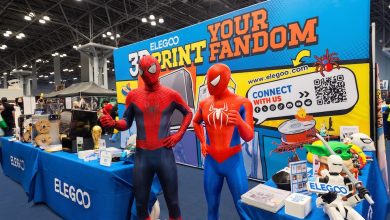
3D printed footwear is coming to MICAM Milano
iSUN3D, eSUN's footwear division, will show a single-component elastic resin and large-format printers built for volume production, as the trade show opens its 102nd edition


MICAM Milano is one of the world’s largest footwear trade fairs, tracing its roots to a 1931 trade show in Vigevano and taking the MICAM name at its first Milan edition in 1969. Assocalzaturifici, the Italian footwear manufacturers’ association, has organized the show since 1974 and runs it twice a year, in February and September; the fair passed its 100th edition in September 2025.
3D printing has entered MICAM’s program gradually, mostly through the MICAM Next talk series and the MICAM X innovation hub rather than the main show floor. Lecce startup Servati, founded by Matteo Di Paola and Marco Primiceri, has shown modular sneakers built around a patented interlocking system that joins a 3D-printed TPU sole to the upper without glue or solvents, so the shoes can be pulled apart and recycled at the end of their life. Elmec3D brought the “Skeleton,” a shoe combining a 3D printed structure made with HP’s Multi Jet Fusion process and a custom-fit inner sock, to MICAM X. NETX has shown finished, ready-to-wear 3D printed models rather than prototypes. Syntilay pairs a 3D foot scan with AI-generated geometry to fit a lattice sole and upper to one wearer. And 4Steps, a project designer Michele Di Carlo started as a 2017 University of Camerino thesis, is a modular 3D printed shoe aimed at children aged 6 to 14, whose feet outgrow standard shoes every few months.

From insoles to shoes
iSUN3D’s footwear line runs on FlexOne, a single-component elastic resin the company launched in November 2025 to remove the mixing step that traditional two-component elastic resins require. Sold ready to print, FlexOne cuts out pre-mixing time and the material waste that comes from mixing errors, and stays stable for more than eight hours after opening, so leftover resin from post-processing can be recycled back into new batches. iSUN3D rates the resin’s tear strength above 50 kN/m, about twice a standard elastic resin under ASTM D624, tensile strength above 20 MPa (three times ordinary elastic resin), and elongation at break above 250% with full recovery. Durability testing shows more than 1 million Ross Flex cycles, extending service life 6 to 30 times beyond conventional elastic materials. The resin is certified non-irritating, non-toxic, and free of heavy metals.
Production runs on iSUN3D’s HSL 100 and 100MAX printers, built for large-format elastic parts on a 16-inch platform with 40 cm of build height. At a print speed of 100 mm per hour, the machines produce two pairs of shoes in three hours, and post-processing is limited to centrifugal and ultrasonic cleaning.
iSUN3D’s move into footwear builds on a longer track record in 3D printed orthotics. Since 2017, the company has produced more than 3,000 customized orthotic insoles a month through a network of over 150 retail partners, work that fed into China’s additive manufacturing standard for customized orthotic insoles and earned recognition from the country’s Ministry of Industry and Information Technology. MICAM Milano marks the company’s push from insoles into full footwear production at scale.

MICAM’s 102nd edition
iSUN3D arrives at the 102nd edition of MICAM Milano with 758 brands on the show floor, 378 Italian and 380 international, from 29 countries; Spain, Brazil, Germany, and Portugal are among the leading exhibitor markets. Buyers are traveling from 130 countries, with established European bases in France, Germany, Spain, Switzerland, Belgium, Poland, and the Netherlands, alongside a consolidated presence from China, the United States, Japan, Kazakhstan, Israel, and Canada. The September edition also brings in buyers from Denmark, Australia, Malaysia, Indonesia, Thailand, Nigeria, and Ghana for the first time.
MICAM Milano president Giovanna Ceolini, who also heads Assocalzaturifici, said the edition centers on expanded incoming buyer programs, a new digital matchmaking platform built with Ice and Maeci, and dedicated lounge and hospitality space for the trade’s business community. The platform lets visitors search exhibitors and collections, message brands, and book meetings before arriving at the fair, paired with a Trends Buyer Guide covering seasonal must-haves. The show’s MICAM Next talk program runs alongside the exhibition floor, covering technology, AI, design, and retail change, and a new Retail Hub area groups accessories, packaging, and store-technology exhibitors. MICAM is also pairing with the circular-economy consortium Retex.Green on the footwear industry’s transition toward extended producer responsibility rules, and its Italian Start Up program includes entrants working on digital design archives and product traceability.
For a trade fair built around leather goods and traditional shoemaking, iSUN3D’s booth marks how far 3D printed footwear has moved from prototyping and orthotics toward production runs, with a resin and printer pairing pitched at volume rather than one-off customization.